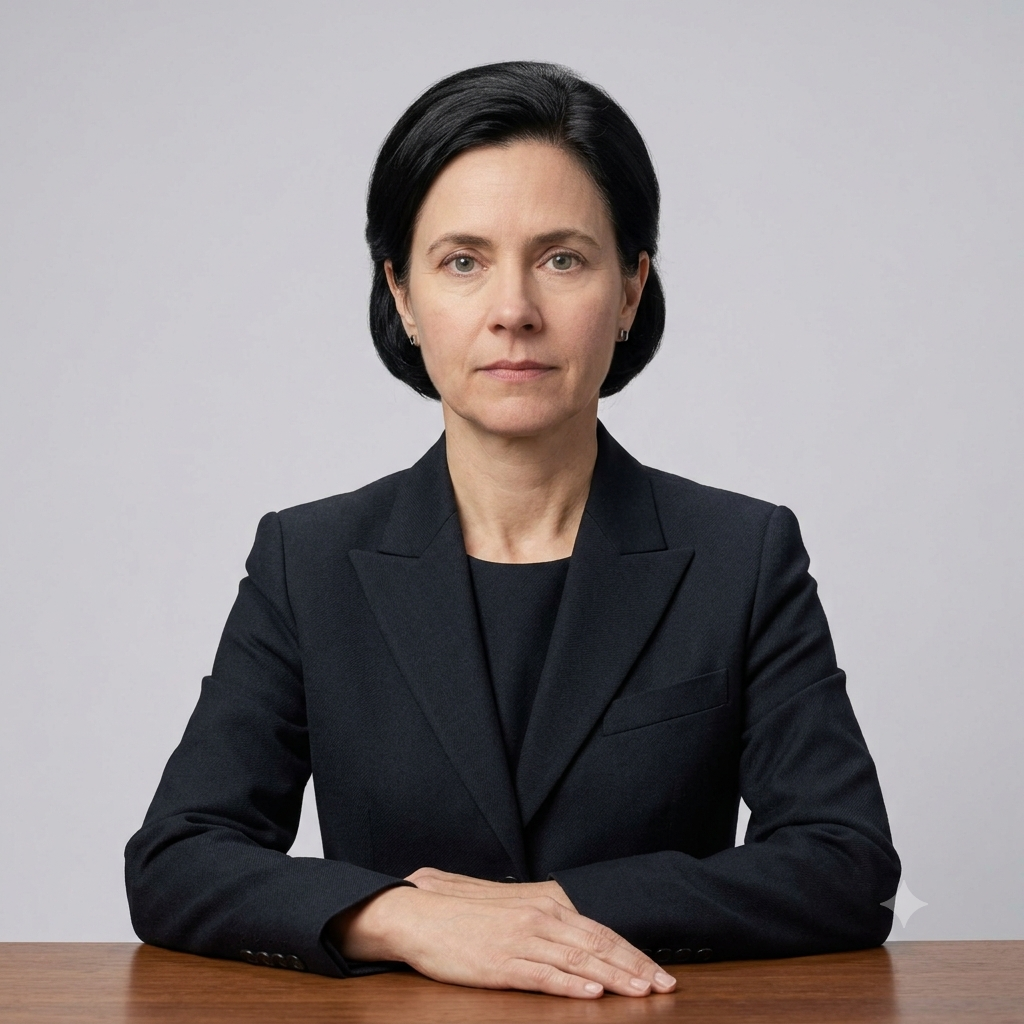
Ines Carrow addressed the Verentum Foreign Policy Forum on Thursday for thirty-five minutes without once saying she was running for Legat Consul. She did not need to. The room had understood that within the first five.
Carrow, who has served as Director of Foreign Affairs under LC Casimir Rehn since Year 10, spoke from prepared remarks to an audience that included sitting ambassadors, three Senate committee chairs, and Rehn himself, seated in the third row. She spoke about continuity, about institutional memory, about the kind of foreign policy knowledge that takes years to build and weeks to lose. She used the word "I" sparingly and the word "we" often. When she said "whoever leads this office in the years ahead," two people in the front row exchanged a look.
"The Republic's relationships in this region are not transactions. They are commitments. And commitments do not expire when administrations change."
Rehn applauded at the appropriate moments. He did not comment to reporters afterward.
The Content
Carrow's remarks were substantive enough to stand on their own as policy, which is part of the point. She spent twelve minutes on the Sunderland situation — longer than Rehn has spent on it in any single public address this year — and was notably more specific about what a regional response framework might look like. "When a nation fractures," she said, "the question is not whether to respond. The question is how to respond in a way that preserves the institutions we will need after the fracturing is over." She called for a multilateral coordination mechanism with Marisvia and Seronne that would formalize refugee burden-sharing before it became a bilateral dispute. She did not explain why this had not already been done.
On Caldris and the river treaty, she was harder than anyone in Rehn's office has been in public. "Water is not a negotiating chip. Any framework that treats minimum guaranteed flow as a concession rather than a right misunderstands both the treaty and the constitution." This drew the evening's longest applause. It also drew attention to the gap between her formulation and the LC's, which has carefully avoided characterizing the negotiations in constitutional terms.
The Positioning
What Carrow is doing is not subtle and is not meant to be. She is the continuity candidate — the person who would carry the Rehn foreign policy record forward while quietly improving on the parts of it that the record shows needed improving. The speech on Thursday was the argument for her candidacy stated in policy language: she knows this terrain, she has been in these rooms, she would not need six months of briefings before picking up the phone to Caldris.
The complication is Rehn. He has not endorsed her and has given no indication he intends to before the election window opens. People close to his office say he is genuine about staying out of it — that the fixed electoral cycle was designed in part to keep the incumbent from becoming a kingmaker, and that he takes that seriously. People close to Carrow's orbit say the same thing, with a slightly different emphasis: Rehn is staying out of it, and that is fine, and she does not need him.
Whether she needs him is a question the next several months will answer. Tobias Vael's entry last month established the race's northern geography. Carrow's Forum speech established her claim on the foreign affairs lane. The candidate who has said the least so far is Seren Mak, the Rhovane Assembly member whose floor speeches on the Korda crisis have given her a profile she did not have at the start of Year 12. Mak's office, asked for comment on Carrow's remarks, offered a three-word response: "We noted it."
Asked directly after Thursday's event whether she was running, Carrow smiled. "I'm the Director of Foreign Affairs for the Federated Republic," she said. "Tonight I gave a speech about foreign affairs." She walked to her car. Her spokesperson did not respond to follow-up questions.
The Elections Panel registration window opens in three months.